
3000 Auckland listings and not one clear buy
My brother and I are looking to buy in South Auckland but it felt like every agent knew more than we did. So I built a pipeline that reads every new Trade Me listing and flags the ones being sold by an agent who’s off their patch.

This was a go at buying a house with the informational advantage on our side for once.
Context
Agents are the experts of their own backyard. They know the price of everything and they know the deals before they go down.
Their mates know it too. They also don’t trust another realtor not to rip them off, so when they sell, they ask the agent they know.
Unfortunately for them, that mate lives on the other side of town. If the house is in South Auckland, that’s my brother’s home field, not the agent’s.
That’s the gap. Find the listings where the agent is working outside the patch they actually know, and the asking price should sit further from the true value (in either direction). Way too high because they’re out of touch, or way too low for the same reason. The low ones could be where we strike gold.
How it’s built
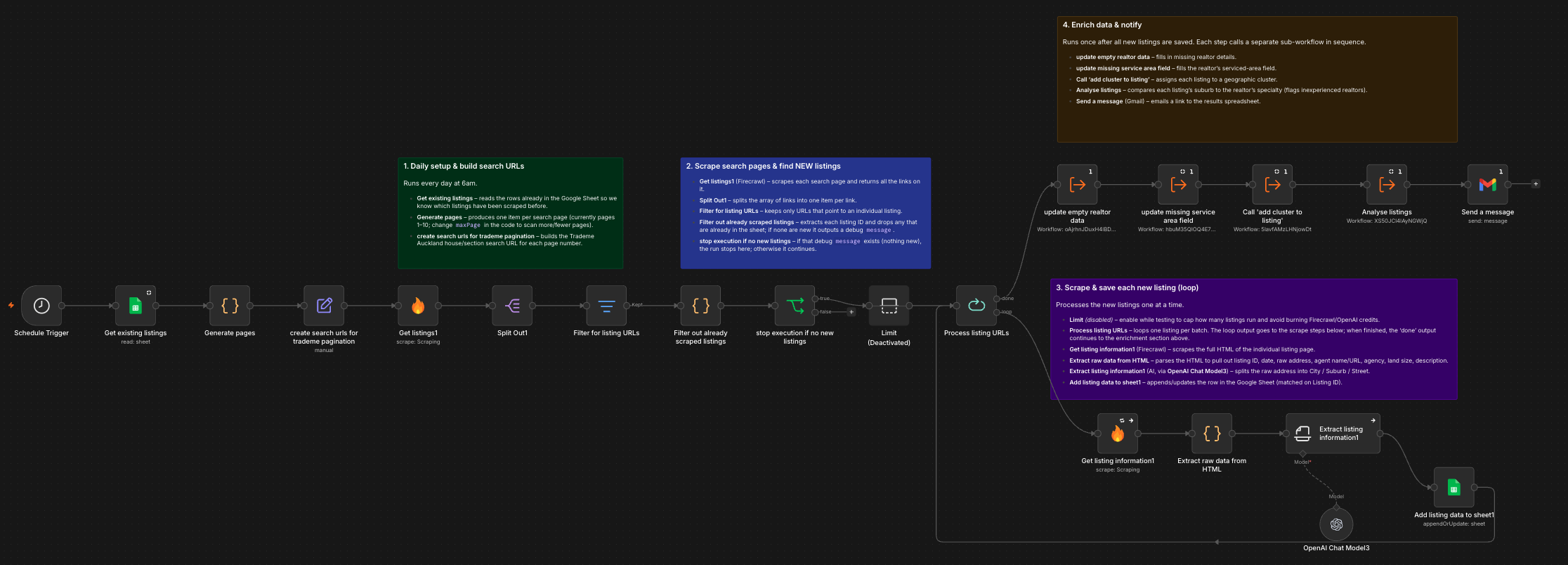
It runs at 6am every day in n8n, and most of the flow is categorising agents and working out whether the agent behind each listing is on home turf.
- n8n6am
1. Schedule Trigger
Forty or fifty new listings come through a day.
- Firecrawl
2. Get listings
Walks the top ten pages of Trade Me’s Auckland results and hands back every listing link.
- Firecrawl
3. Get listing information
Scrapes the listing page itself, one at a time.
- n8n
4. Extract listing information
Pulls out the agent, the agency, the land size and the date, with an OpenAI step splitting the raw address into city, suburb and street.
- Firecrawl
5. Get agent profile
The regions the agent says they’re active in, off their Trade Me profile.
- n8n
6. Categorise the agent’s speciality
Checks those stated regions against their latest listings, then settles on the patch they actually work.
- n8n
7. Analyse listings
Maps the listing’s suburb and the agent’s patch onto the same Auckland clusters, then checks whether they match.
- Google Sheets
8. Store results
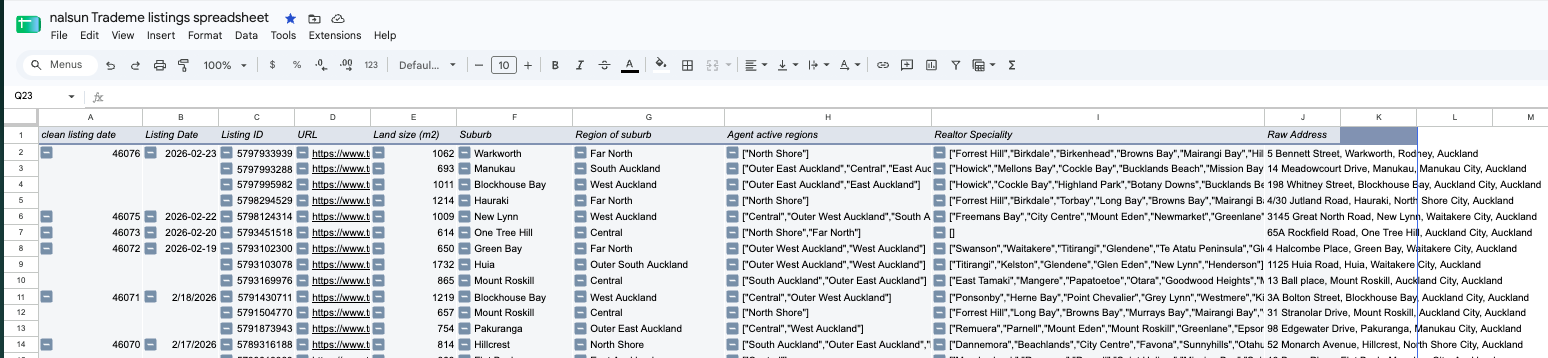
One row per listing and one row per agent, each listing carrying its off-patch verdict.
- Gmail
9. Send a message
Emails a link to the results sheet.
The stack
- n8n · Runs the daily flow, the deduping, and the categorising.
- Firecrawl · Scrapes the search pages, the listings, and the agent profiles.
- Trade Me · Every listing and every agent profile comes from here.
- Google Sheets · One row per listing, one row per agent.
- OpenAI · Splits each raw address into city, suburb and street.
- Gmail · Emails me the link to the sheet when a run finishes.
Working out where an agent actually sells
Every agent profile lists the regions they say they’re active in. Those get checked against their latest listings to see whether they’re accurate, then mapped onto a cluster of Auckland. The listing’s suburb gets mapped onto one too, and the check is whether the two match.
Learnings
Two months of running it turned up something I wasn’t looking for.
- Twelve hundred agents. That’s how many were active in Auckland alone while I ran this, against forty or fifty new listings a day. Which mostly scares me. The housing market here is lucrative enough to keep that many people fed.
- The hypothesis was half right. Out of patch agents do misprice, and they just about always misprice high. That call was my brother’s. There’s no price anywhere in the sheet, so he made it off his own feel for the market. Of the 268 that made the shortlist, nothing looked like a clear buy.
- Spreadsheets were the wrong container. I put it all in a spreadsheet so my brother and I could both look at it easily, and for that it worked. What it cost me was everything after: the data was much harder to clean and keep straight. Next time it’s a proper database with one view pushed out to him.
- Firecrawl is very good at the boring bit. It hands back clean HTML from a page that’s a mess, and it finds the URL you need with intent rather than off the structure of the page. I’ve since learnt that’s a non-trivial problem.
- Pin your data. This was my first n8n build, and I paid Firecrawl to re-scrape everything every single time I wanted to test one step. Pinning it once and testing against that is faster and free.
- Treat n8n like code. Everything goes in a function with clear inputs and outputs, or memory runs out and the app breaks.
Property insights
The sheet was still sitting there after we paused, so I went back through it properly. Everything below is the Auckland listings on sections over 600m², which is 2091 rows of the 3000.
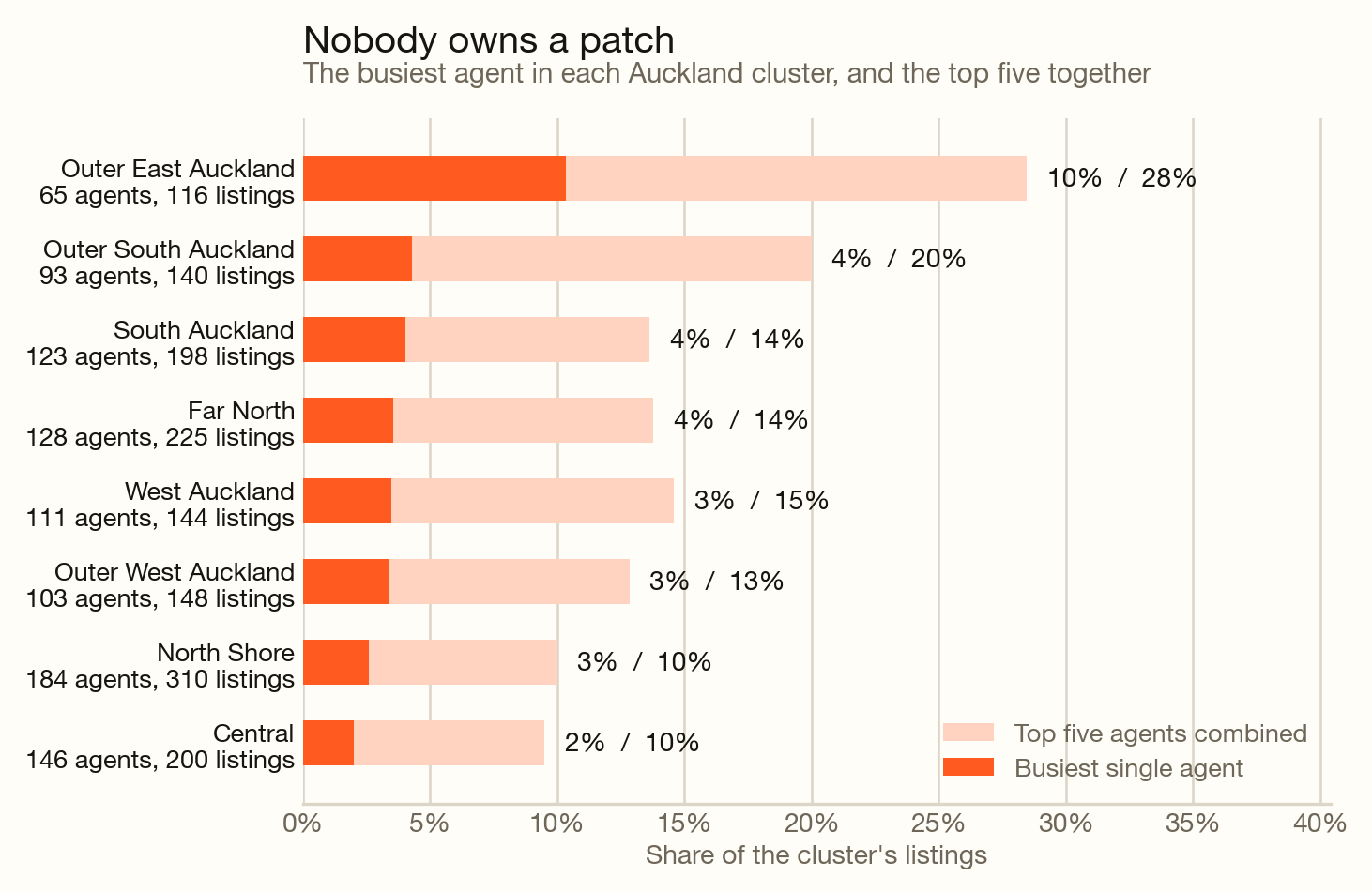
- Nobody owns a patch. The busiest agent in any cluster holds between 2% and 10% of its listings. Central is the most competitive, with 146 agents splitting 200 listings between them.
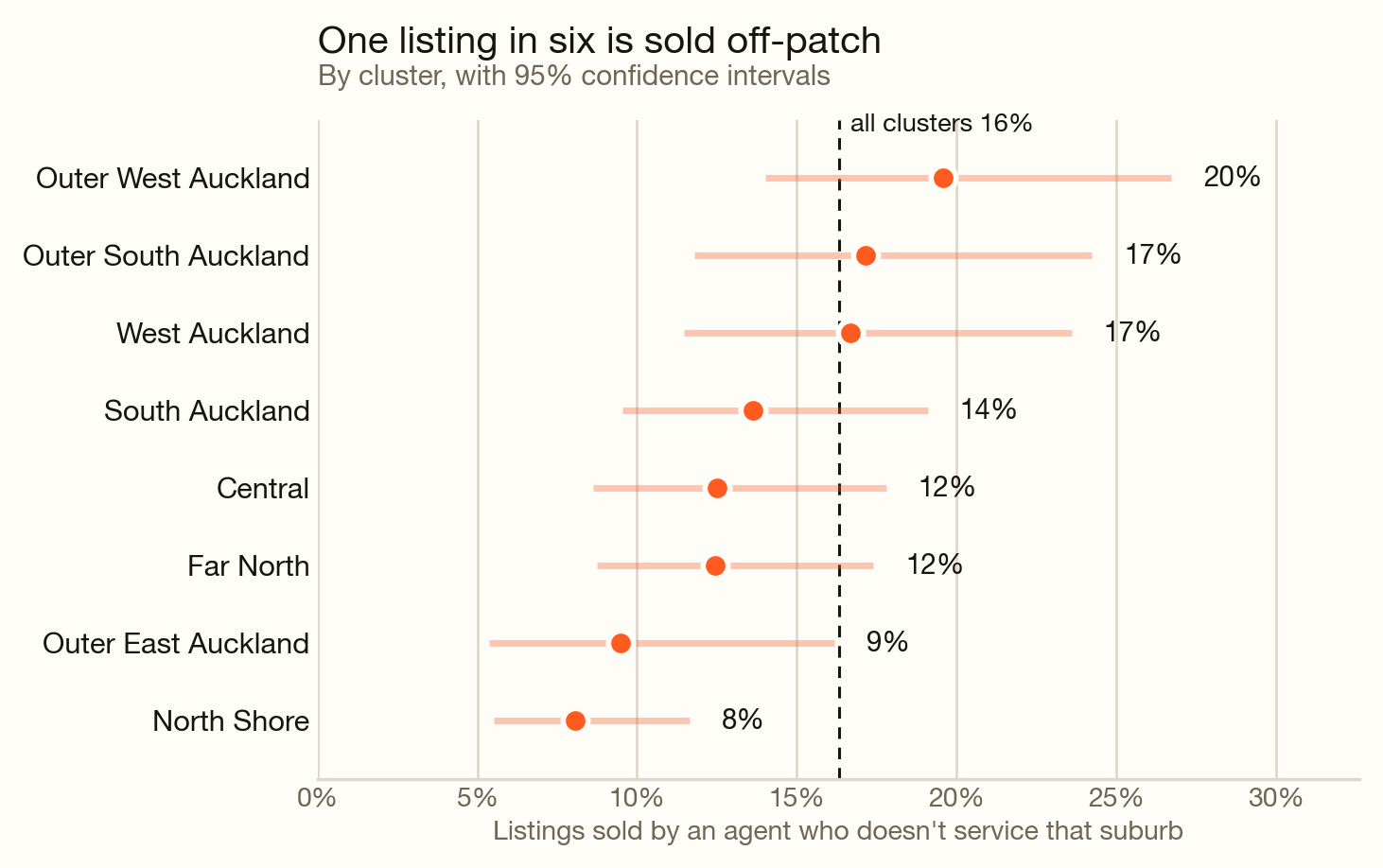
- One listing in six is sold off patch. 16% of the listings the check could score had an agent whose service area doesn’t cover that suburb. The North Shore is the tightest at 8%, Outer West the loosest at 20%.
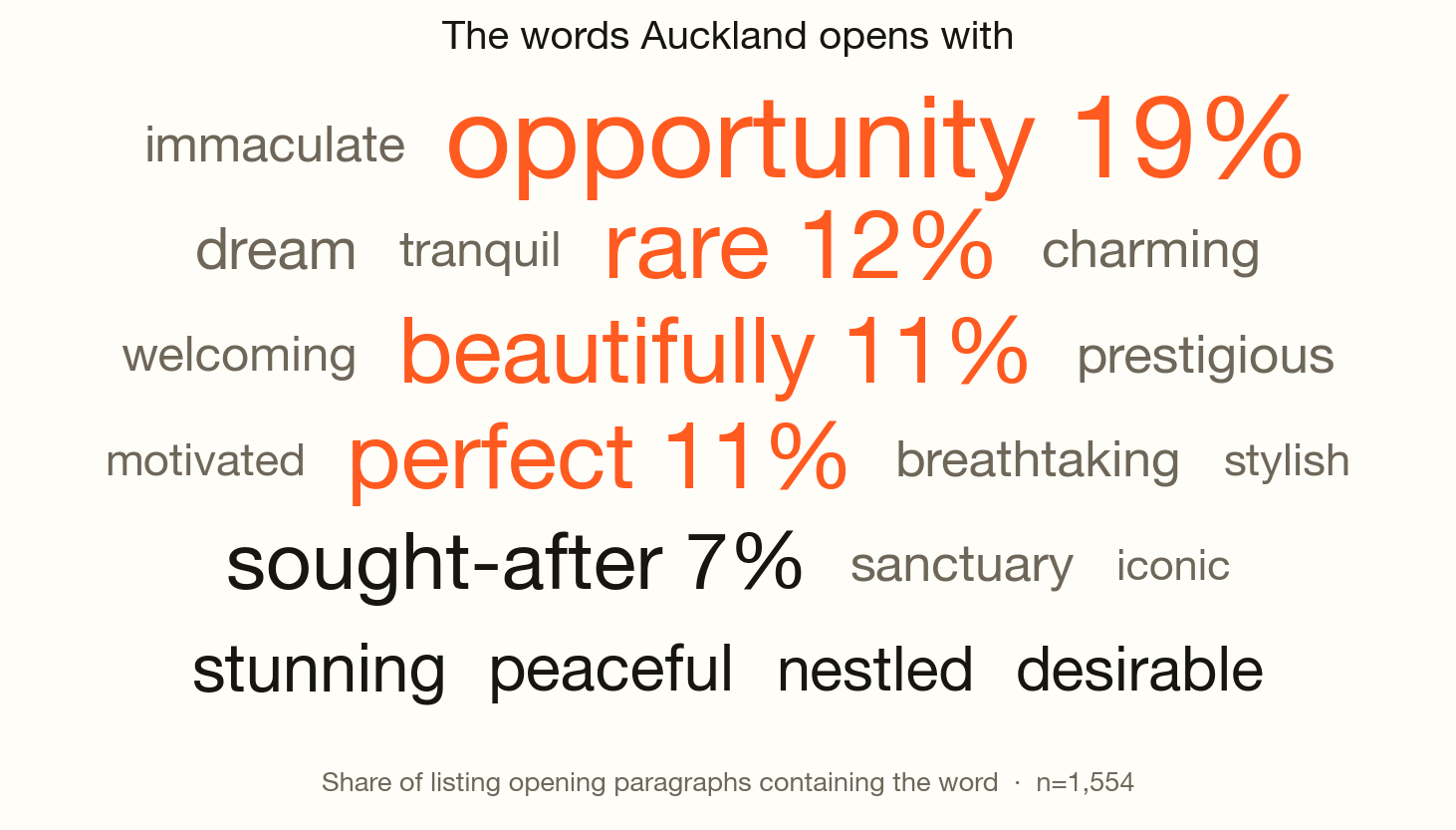
- 19% of listings start with opportunity. Agents reach for the same words when they write the hook for a property. Opportunity leads at 19%, then rare at 12%, and only after those do you get the words that describe the home itself.
Next steps
What’s still broken
The shortlist never surfaced a good buy across 3000 listings, so we paused it.
What I want to build
The plumbing is flaky. I’d add retry paths and a lot more testing to the app before I left it running hands off.
The collection and processing logic does work though, so I’m keen to point it at another hypothesis and go looking for mispricing somewhere else.
I went looking for agents who didn’t know what a house was worth. What I found is that being off your patch makes you price high, which is no use to a buyer. The hypothesis didn’t hold, but the collection and analysis stack did.